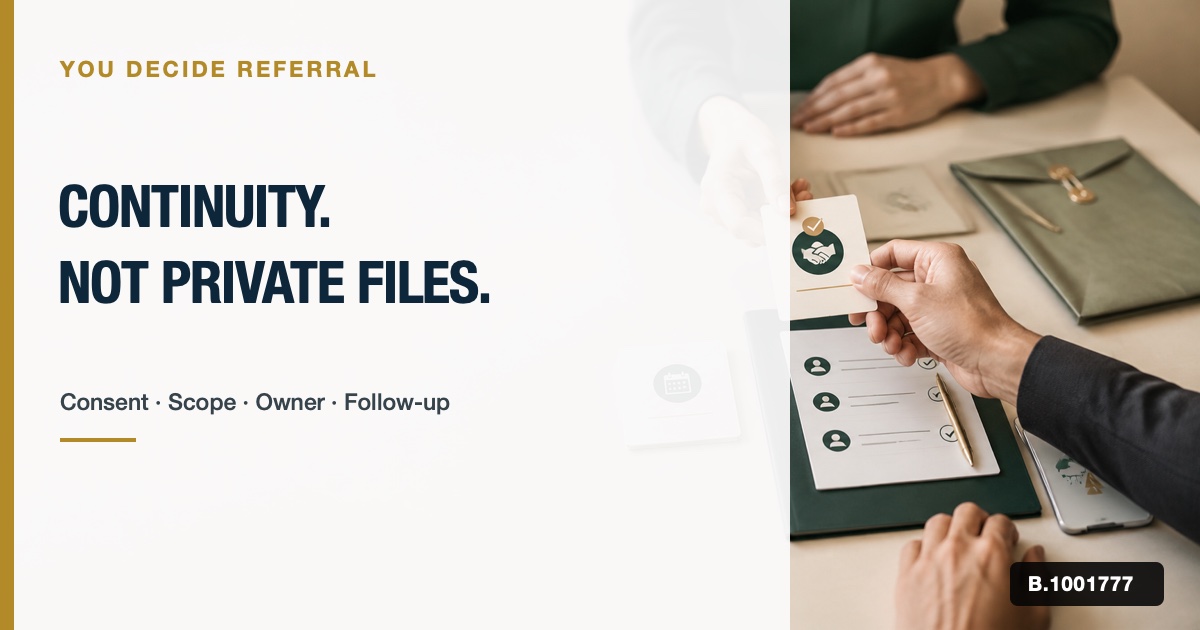
A good referral handoff preserves continuity across those roles. It does not forward the client’s private emergency file.
1. Confirm consent and referral scope
Ask what the client authorizes the referring agent to share, with whom, and for what purpose. Verify the receiving broker or agent’s current license and role. If an agent is referral-only or inactive, keep activity inside the permitted scope and route brokerage services through the properly licensed receiving team.
2. Share the minimum useful continuity card
The handoff can state the client’s preferred contact method, the property or market involved, the current transaction stage, any time-sensitive official alert affecting the next appointment, and the named owner of the next action. It usually does not require policy documents, account numbers, tax returns, identification, medical details, access codes, or complete emergency plans.
3. Route specialist questions instead of translating them
Insurance coverage goes to the licensed insurer. Engineering and property-condition questions go to the applicable inspector or engineer. Emergency instructions come from public authorities. Tax and legal consequences go to the CPA and attorney. The receiving agent coordinates the property work without taking over another professional’s conclusion.
4. Close the loop with a dated acknowledgment
Record when the receiving professional accepted the handoff, what next step was agreed, and when the client will hear back. If an appointment or property visit must change because of an official warning, use the verified contact method and preserve a concise status—without copying a broad group into private information.
Example: a useful handoff without the sensitive attachments
A referring agent learns that a relocating client’s planned inspection route may be affected by an official flood alert. The agent obtains consent, verifies the Nevada receiving team, shares the appointment, preferred contact channel, official alert link, and need for a route confirmation, then records who will call the client. The insurance policy and medical details stay with the professionals who need them.
FAQ
Should a referring agent send the client’s insurance policy with the introduction?
Not by default. Share only what the client authorizes and the receiving professional needs. Policy analysis belongs with the licensed insurer, using an appropriate secure channel.
What if the referring agent is inactive or referral-only?
Verify current license status and permitted scope before acting. The properly licensed receiving brokerage should handle regulated brokerage services in its jurisdiction.
What proves that continuity was preserved?
A consent record, verified roles, a concise handoff, one named next-action owner, a due date, and acknowledgment from the receiving side. A sent email alone does not prove acceptance or follow-up.
Primary sources and limits
Clark County Fire Department Flash Flood Safety and Ready.gov planning resources. General referral-process education only—not emergency, insurance, engineering, legal, tax, privacy, or brokerage-law advice. Verify licenses, brokerage policies, client consent, jurisdiction, secure-transfer requirements, and the responsible professional for each question.
Make the next safe contact explicit.
Use current documents and the right professionals before deciding.
Request a scope conversation