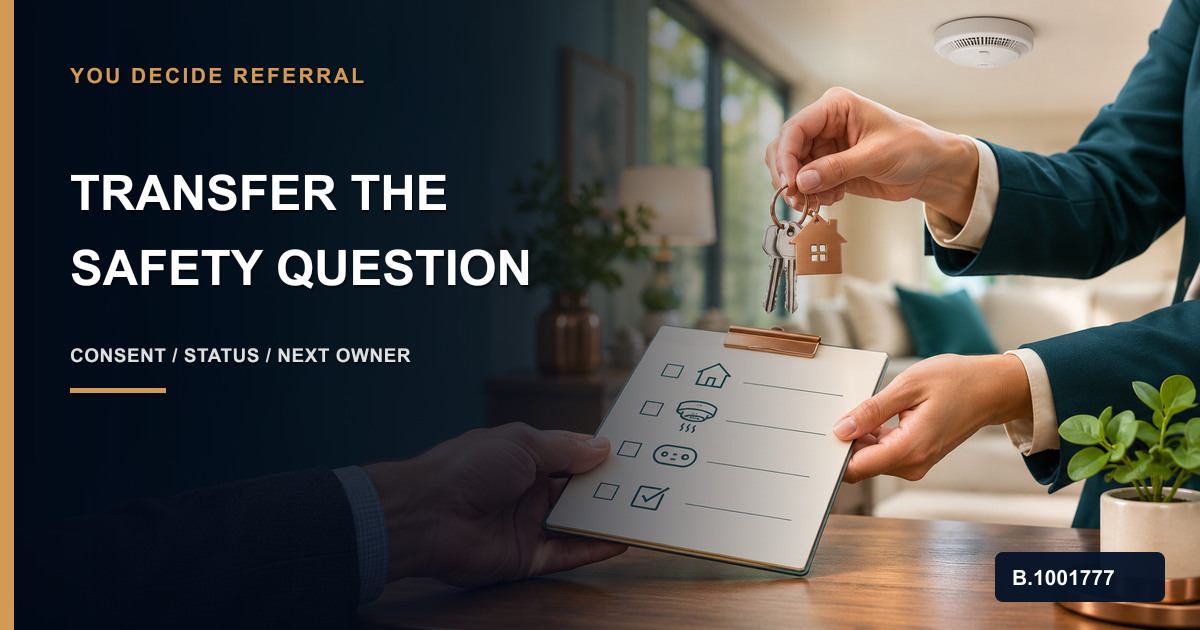
A real estate referral home safety checklist should transfer the client's consent, exact property and use, the smoke- or carbon-monoxide question in the client's own words, current inspection or repair status, relevant dates, and one next owner. It should not turn an agent into a code official, inspector, technician, insurer, or lawyer. The receiving professional needs a clean continuity record that identifies what is known, what is only reported, and which qualified person must answer each open question.
Get consent and send the minimum useful facts
Confirm what the client authorizes the sending professional to share, with whom, for what purpose, and through which secure channel. Include property address only when authorized, transaction role, intended use, deadline, and the exact alarm or heating question. Do not send security codes, full inspection reports, medical details, access instructions, or private documents through a casual referral message unless the client has authorized the appropriate secure route.
Describe status with evidence-based verbs
State whether the concern was noticed, reported by the client, photographed, included in a seller disclosure, observed by an inspector, evaluated by a technician, quoted, agreed for repair, completed, invoiced, permitted, reinspected, or verified at final walkthrough. Preserve the source and date. A photo is not a code ruling; an invoice is not necessarily proof of current operation; a sent repair request is not an accepted agreement.
Route each question to the right professional
The broker or agent coordinates transaction scope and documentation. Inspectors and qualified technicians evaluate devices and equipment within their scopes. Local authorities interpret applicable requirements. Insurers and lenders decide their conditions. Attorneys address legal questions. For a 1031 client, the QI, CPA, and attorney handle exchange structure and tax analysis. Record the referral, but do not supply an individualized technical, legal, tax, lending, or insurance conclusion.
Carry dates, access, and property-use context
Include the client's stated occupancy or rental plan, property type, number of levels, attached garage or fuel-burning systems if known, inspection and due-diligence dates, repair deadline, vendor access, final walkthrough, closing target, possession, and emergency concern. Keep service neutral and tied to the client's stated property criteria. Do not use household composition, disability, age, or other protected information to steer locations or service quality.
Close the loop with acceptance and a receipt
Verify the receiving Nevada license status through the Nevada Real Estate Division, confirm the recipient accepts the geographic and service scope, document compensation separately, introduce the client, and record the first next action. Ask for receipt of the safety question and the identity of the person who will route it. A verified license does not prove acceptance, and an accepted referral does not prove a repair, compliant property, closing, or client outcome.
FAQ
Should the sending agent interpret a smoke or CO alarm requirement?
No. Transfer the exact question and available evidence, then route it to the responsible local authority, inspector, qualified technician, broker, insurer, lender, or attorney as appropriate.
Can an inspection report be emailed with a referral?
Only through an authorized and appropriately secure route. Confirm client consent, document ownership, recipient, purpose, and the minimum information needed before transferring private records.
Does a Nevada license lookup prove the referral is accepted?
No. Verify current public status, then separately document acceptance, scope, client introduction, next action, owner, due date, and receipt.
Primary sources and limits
- Clark County Fire Department, Carbon Monoxide Safety
- U.S. Consumer Product Safety Commission, Keep Warm and Safe This Winter
- U.S. Consumer Product Safety Commission, Carbon Monoxide Fact Sheet
- Nevada Real Estate Division, License Lookup
- HUD, Fair Housing Act overview
General education only. An alarm, test button, indicator light, photograph, seller statement, inspection observation, invoice, repair request, work order, permit, license lookup, referral, exchange agreement, identification notice, or closing record does not by itself establish sensor accuracy, safe equipment, code compliance, completed repair, insurance coverage, lender approval, property suitability, professional acceptance, exchange qualification, basis, gain, deferral, or closing. Verify the exact property, jurisdiction, use, building and fire requirements, manufacturer instructions, device model and age, power, placement, fuel-burning systems, garage, inspection scope, technician findings, repairs, permits, insurance, lender conditions, leases, tenant notices, taxpayer, vesting, QI controls, exchange dates, receiving license, client consent, secure channel, accepted scope, owner, and completion evidence with the responsible broker, local authorities, fire department, inspectors, qualified technicians, insurer, lender, property manager, qualified intermediary, CPA, attorney, title or escrow provider, and other qualified advisers. No individualized legal, tax, lending, insurance, securities, appraisal, inspection, code, fire-safety, property-management, fair-housing, brokerage, or investment advice is provided.
Related: coordinating HVAC inspection questions, using evidence-based referral status, contact You Decide Referral.