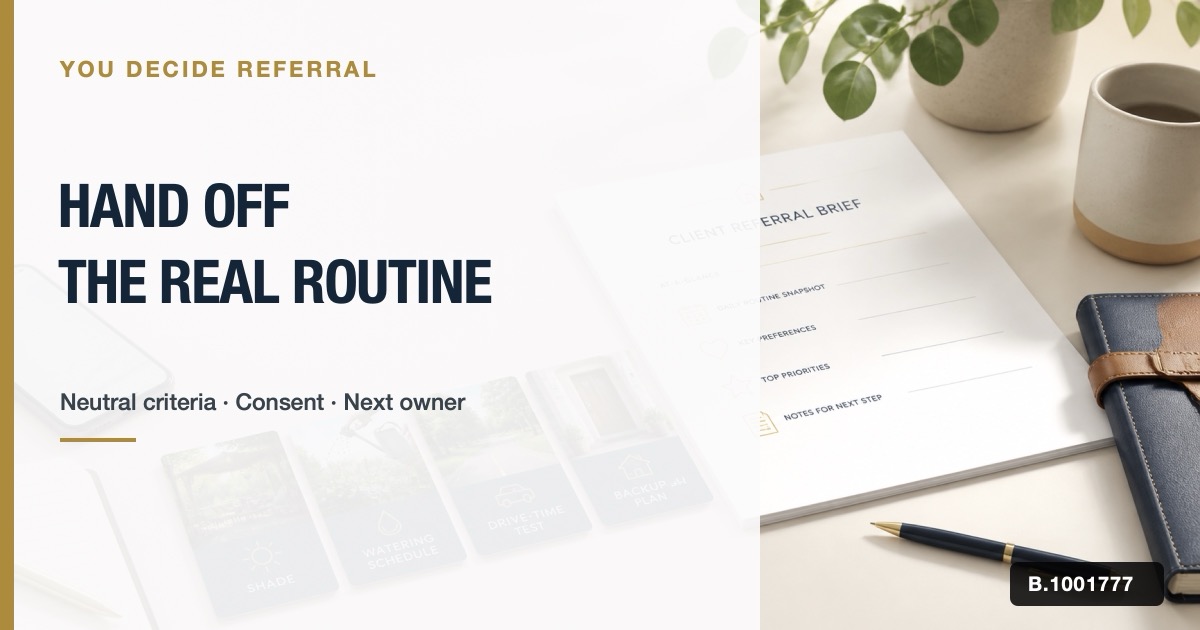
The four-line routine brief
- Shade: when and where the client expects to use outdoor space.
- Water: which property features matter—desert landscaping, lawn, pool, shared maintenance, or no preference yet.
- Travel: the client-selected destinations and time windows worth testing.
- Backup: access, power-dependent needs, pets, mobility, or work continuity the client chooses to discuss.
Use the client's own language. Do not translate “short drive” into a guarantee or “quiet” into a demographic proxy.
Verify the receiving role
Before sharing the brief, confirm the receiving professional's identity, active license status where applicable, brokerage, geography, and accepted scope. A referral handoff is not complete merely because a similar name appears online or a message was sent.
Share only what is needed
Record consent and share the minimum useful facts. The routine brief does not need medical records, government ID, financial documents, children's information, or a detailed work schedule. If a client raises an access or disability-related need, preserve the client's requested property function without making assumptions or broadcasting private details.
Close the loop with one dated action
Name who contacts whom, by which approved channel, and when the referring agent checks the result. The receiving agent should confirm the scope and the next real-estate step. The referral source can then verify continuity without directing work outside the source's role.
Example
Weak: “They want a safe, family neighborhood close to everything.”
Useful: “With client consent: prefers usable patio shade after 4 p.m.; wants low-maintenance landscaping; asks to test the weekday route to a named workplace between 7:30 and 8:00 a.m.; wants to understand gate access during an outage; receiving agent confirms contact Thursday; referring agent checks Friday.”
The second version uses neutral, observable criteria and a dated handoff.
FAQ
Should a referring agent recommend a neighborhood from lifestyle labels?
No. Capture neutral client criteria and connect the client with an appropriately licensed receiving professional. Avoid protected-class information and demographic proxies.
Should private documents be attached to the routine brief?
Not by default. Share only client-authorized information that is reasonably needed, using an approved secure channel when sensitive material is truly necessary.
When is the referral handoff verified?
After the receiving professional's identity and role are confirmed, contact is acknowledged, and the next real-estate action is documented—not when the introduction is merely sent.
Primary sources and limits
- Southern Nevada Water Authority 2026 Water Resource Plan
- Las Vegas Valley Water District conservation rules
- Clark County emergency planning
Southern Nevada Water Authority 2026 Water Resource Plan; Las Vegas Valley Water District conservation rules; Clark County emergency-planning guidance. General brokerage education only. Referral duties, license status, privacy, agency, compensation, fair-housing compliance, and professional scope are fact-specific and may require broker or counsel review.
Build a neutral, consent-based relocation handoff.
Use the address-specific facts and the right professionals before deciding.
Request a scope conversationInactive vs. referral status · Referral status and Form 505 · All briefs